Who wants to be an ISA millionaire?

Believe it or not, an increasing number of Brits are reaching the impressive milestone of having a million pounds in their ISAs. In fact:
- There are now more than 5,000 ISA millionaires in the UK.
- The number of investors with seven-figure ISA balances has surged by over 1,000% in the past seven years.
- The top 25 ISA investors have average holdings of £1,305,000.
We have gathered research from UK brokers and Freedom of Information requests to explore how these ISA millionaires achieved their wealth and how you can adopt some of their habits to do the same.
Please bear in mind that all investments have risk.
How much are most people saving in their ISAs?
Before we explore the ISA millionaires, it's important to consider what the average Brit has saved.
According to the latest government statistics, we collectively hold approximately £872 billion in UK ISAs, which is more than ever before. In the year 2023-24 alone, a record £103 billion was invested in ISAs, and the uptake reached its highest level in 13 years as of September 2025.
On an individual basis, the amount saved can vary significantly, largely depending on factors such as income, age, and location. Currently, the average ISA pot stands at around £34,000.

Unsurprisingly, those earning more money typically have more saved.

Unsurprisingly, older people have more tucked away on average than younger people do.
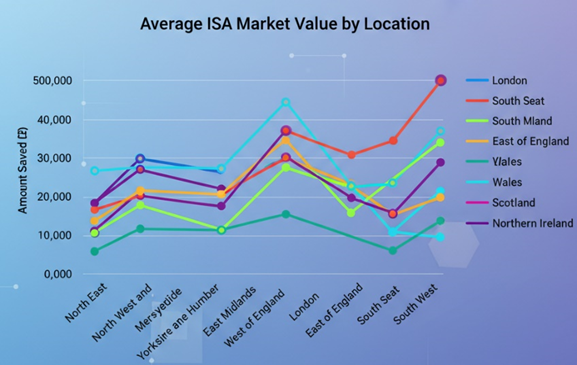
While London ranks high in average savings, the South East slightly surpasses it in terms of the amount saved per ISA saver.
The patterns are quite evident: generally, the higher your income, the older you are, and the wealthier your location, the more you are likely to have saved.
The type of ISA you choose also plays a significant role.
Data shows that across all income groups, the average balance in cash ISAs is considerably lower than that in stocks and shares ISAs.

If looking at that graph feels a bit discouraging, it's important to remember that the figures for lower income brackets in stocks and shares ISAs are likely influenced significantly by pensioners who have saved in a stocks and shares ISA for years before retiring and are now drawing a smaller income. It may also reflect company owners whose income appears lower on paper.
The contrast between stocks and cash becomes even more pronounced when we consider the overall market.
Currently, stocks and shares ISAs account for approximately £511 billion of the total ISA market, while cash ISAs hold about £360 billion. This means that around 59% of the total ISA market value is invested in stocks and shares, with only 41% in cash. Interestingly, despite this, about 60% of all ISA subscriptions still go into cash ISAs.
But where are all the millionaires?
Although details about ISA millionaires are not included in publicly released figures, it's likely that there are several future seven-figure savers among the available data.
ISAs have only been in existence since 1999, meaning that no one in the UK has had the opportunity to benefit from one throughout a full working lifetime—though many will in the future.
Consider a 25-year-old who currently has £10,000 in their ISA, which is the average amount held by those in the 25-34 age bracket. If they invest their money, instead of keeping it in cash, and achieve an average annual return of 7%, they could reach the impressive milestone of £1 million by contributing £350 each month until retirement. Is it challenging? Yes. Does it come with risks? Yes. Is it achievable? Also yes.
Now, let’s focus on the real high-flyers: how many individuals have transformed their ISAs into substantial fortunes, and what do we know about this exclusive group?
How many ISA millionaires are there, and how much do they have?
Since HMRC began tracking seven-figure ISA holders in 2016, the number of ISA millionaires has increased every year up until 2023, the most recent data available, with only a minor dip during the pandemic.
According to the last official count, there were 5,070 ISA millionaires, though most estimates suggest that this number has now climbed to at least 7,000.

Most ISA millionaires are, as you’d expect, hovering just above the million-pound mark. But a select few have managed to build genuinely extraordinary pots:
ISA wealth bracket | Number of ISA millionaires |
£1,000,000 – £1,999,999 | 4,800 |
£2,000,000 – £2,999,999 | 200 |
£3,000,000 – £3,999,999 | 30 |
£4,000,000+ | 50 |
(These figures add up to more than 5,070 due to the way the data was rounded in the FOI request)
Reaching that top £4 million bracket would firmly place you in the category of being “lucky (or exceptionally skilled).” To achieve this, you would need to have maximised your ISA allowance every single year since the launch of ISAs and achieved an average annual return of 18%. This level of return is well beyond what even most professional investors manage over decades.
In reality, some of the earliest and largest ISA fortunes also owe their success to historical factors. Before the introduction of ISAs, there were Personal Equity Plans (PEPs), which were launched in 1986 and later merged into the ISA system. Older investors who maximised their PEP allowances and continued this habit with ISAs gained a significant head start compared to others.
What ISA millionaires do differently
We have the figures: the number of ISA millionaires, the total amounts they’ve managed to save, and the challenges of joining their ranks. However, numbers alone don’t convey the entire picture.
What truly matters for anyone looking to follow in their footsteps—or simply curious about their lifestyle—is understanding what these ISA millionaires do differently.
Let’s explore this further.
They use a stocks & shares ISA
One common trait among ISA millionaires is that nearly all of them—94%—achieved this milestone through investing.
The remaining 6% reached their goals by using a combination of stocks and shares along with cash savings.
This positions ISA millionaires quite differently from the average saver. Across the UK, cash ISAs are approximately twice as popular as stocks and shares ISAs, and around three-quarters of adults do not invest outside of their workplace pension.
Experts believe this preference stems from the widespread belief that the stock market is too risky, making cash the safer alternative.
However, over the past decade, the average return on cash ISAs has been only about 1%—a rate that fails to keep up with inflation. In contrast, average returns for stocks and shares ISAs have approached 9%, significantly outpacing inflation and providing a noteworthy boost.
Of course, the standard investment warning applies: past performance is no guarantee of future results, and the next decade may present different circumstances. Nevertheless, the long-term trend is difficult to overlook—broad, diversified investments have historically outperformed cash savings.
It's important to acknowledge that many people choose to save in cash because they anticipate needing the money in the short term, as opposed to investing for the distant future.
Lastly, it's worth noting that most ISA millionaires did not aggressively invest in stocks and shares right away; they likely had other financial foundations in place before doing so.
They stick to a financial plan
It probably comes as no surprise that the vast majority of ISA millionaires consistently max out their ISA allowance each year, a practice they have maintained since 1999.
However, aspiring to join their ranks doesn’t necessarily mean you have to do the same (though it would certainly help). What matters more is having a realistic and achievable strategy and sticking to it year after year. Patience is also crucial; on average, it takes around 22 years for ISA millionaires to reach their goal.
Even if you don’t have large sums to invest each year, time and consistency can still significantly contribute to your success.
Let’s say you start at 25, investing £200 a month. If you keep it simple and invest all of it into a highly diversified index fund, you can expect average returns. While returns are never guaranteed, the global stock market has historically averaged around 9% a year, so we’ll use that as a benchmark.
Using a compound interest calculator, you would reach £1,000,000 in about 42 years—just in time to retire at 67.
If you doubled your contributions to £400 a month, it would take you about seven years less to reach the same amount.
A more realistic approach might be to start with a smaller amount and increase your contributions whenever you can afford it. For instance, you could start saving £100 a month and increase your contributions by 5% each year as your earnings (hopefully) rise. Assuming average returns of 9%, you would still reach that million in around 42 years.
Whatever your plan, unfortunately, there aren’t really any shortcuts unless you already have considerable funds to start with.
They reinvest dividends
This is another strategy that distinguishes millionaires from those who are nearly there.
Investment funds generally come in two types: “income” (or dividend) funds and “accumulation” funds. While both types hold the same investments, accumulation funds automatically reinvest dividends—the regular payouts you receive for holding a fund—whereas income funds pay them out as cash.
This distinction can have a significant impact, particularly due to the power of compounding. Every reinvested dividend begins to earn its own gains and dividends, which are then also reinvested, creating a snowball effect.
For instance, if you invested £10,000 in a fund that grows at 5% per year and pays 3% in annual dividends, you would end up with an additional £20,000 in growth over 20 years by reinvesting the dividends, compared to taking them as income.
Of course, some people need or prefer the income from their investments, or they may choose to reinvest dividends manually—either back into the market or elsewhere.
Regardless of the approach, reinvesting dividends can have a substantial impact over the long term.
They don’t trade a lot
It’s easy to imagine the typical stock market "winner" as someone glued to a screen full of charts and arrows, frantically buying and selling, with sweat dripping onto their keyboard. However, research indicates the opposite is true.
Individuals who accumulate wealth through investing tend to make thoughtful decisions and hold onto their investments for the long term, even when the market appears challenging.
Over the past 30 years, if you had invested in the S&P 500 (which includes the 500 largest publicly traded companies in the US) but missed just 10 of the best market days, you would have ended up with only half as much money. Notably, the best and worst market days often occur close together.
Active trading is successful for a very small number of people, primarily those working for major firms, rather than young individuals selling courses and tips on platforms like Discord. In fact, for most people, active trading can be detrimental.
They prefer investing in individual stocks and focus on the UK market
What differentiates ISA millionaires from other investors is their tendency to invest more heavily in UK-listed shares.
Both Hargreaves Lansdown and Charles Stanley have observed that their millionaire clients hold a higher percentage of UK assets compared to the average investor. For instance, around 44% of the portfolios of HL's ISA millionaires are allocated to UK assets, while this figure is only 38% for all other investors. To provide some context, the UK constitutes just 5-7% of a typical global index fund.
Why do ISA millionaires favour homegrown investments? One reason could be their age; ISA millionaires are generally older, and many may rely on their portfolios for income. UK shares, which are primarily associated with banks, insurers, and other sectors that offer substantial dividends, provide better payouts. Another factor might be psychological comfort; it often feels safer to invest in familiar territory.
Another noteworthy trend is that both AJ Bell and Charles Stanley have found that their millionaire clients tend to hold significantly more individual stocks than the average investor.
This practice contradicts traditional investment advice, which typically emphasises the importance of maintaining a well-diversified portfolio. However, we may be experiencing survivorship bias here— we are hearing from those whose stock selections were successful, rather than from those whose high-risk investments did not pan out.
Additionally, it is a straightforward numbers game: when your portfolio already has hundreds of thousands invested, you can afford to gamble on a few unconventional shares without jeopardising your entire investment.
For most people, diversification—through mutual funds and global investments—remains the safer and more prudent approach. Nonetheless, it's fascinating to observe the investment habits of those who have already reached the million-pound milestone.
When £1 million isn’t what it used to be…
Of course, this information is particularly valuable for those who are already sitting on a substantial nest egg and nearing retirement. But what about younger savers or those just starting out?
With inflation gradually diminishing the value of money, a £1 million target in the future may not be as unattainable as it once seemed; however, it will not purchase as much as it does today. As both salaries and living costs increase, you will need more than just a target figure to maintain the same lifestyle.
In fact, if we assume that inflation remains at 3% over the coming decades—above the Bank of England’s target rate but closer to the UK's recent average—a 25-year-old today would need to save over £3 million by retirement age to preserve the purchasing power of £1 million today. Even a 50-year-old would need to save an additional £500,000 or so.

The ISA (Individual Savings Account) allowance is intended to rise with inflation, but it has remained at £20,000 since 2017 and is expected to stay frozen at this level until at least 2030. During this time, prices have increased by approximately 35%, resulting in a real-term reduction of about £6,000 in the annual allowance's value.
As a consequence, younger and even middle-aged savers are at a disadvantage, finding it much more challenging to accumulate a savings pot that maintains the same purchasing power as previous generations. When you consider that wages are barely keeping pace with inflation, it's evident that the odds are now significantly more daunting than before.
However, by the time today's twenty-somethings reach retirement age, the world may be quite different. The ISA allowance might increase to £50,000, salaries could automatically adjust for inflation in real time, and we may even find ourselves commuting in flying cars—or at the very least, in driverless Ubers.
Conclusion
So what’s the lesson behind all this? Mostly that becoming an ISA millionaire is a recipe with four ingredients:
A decent amount to invest
Time
Patience
Luck.
Most people fall short in at least one of those areas. Maybe you aren’t earning a lot, perhaps you struggle to remain consistent when life gets challenging, or you might panic-sell at the first sign of market fluctuations. This is just part of being human.
The real key lies in consistently showing up and doing the seemingly mundane tasks as frequently as you can, for as long as you can manage it. Will you end up swimming in gold coins like Scrooge McDuck? Probably not. However, you will be much better off than if you hadn’t made the effort. While it's not guaranteed, history suggests that the odds are in your favor.